Stack Processing for Credit Reporting: How It Works
How stack processing enables high-volume Metro 2 submissions with automated validation and error recovery.
What Is Stack Processing in Credit Reporting?
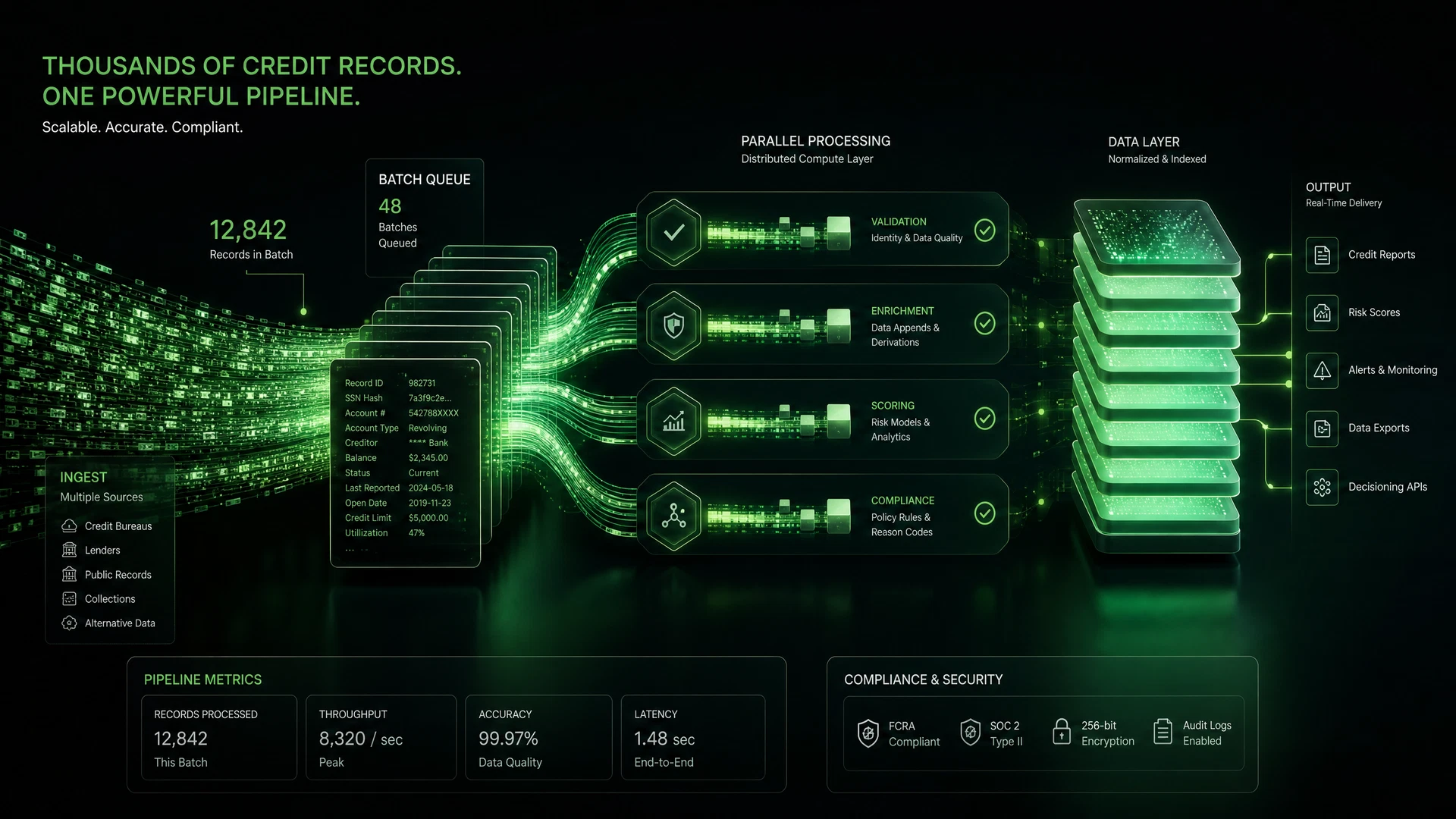
Stack processing refers to the batch processing of large volumes of credit records through a structured, sequential pipeline. In the context of Metro 2 credit reporting, stack processing is the mechanism that takes raw account data from your source systems, transforms it into Metro 2 format, validates each record against CDIA compliance rules, and assembles the final submission file for bureau delivery.
For organizations with large credit portfolios — lenders with thousands of accounts, servicers managing multiple loan pools, or collections agencies with high-volume account inventories — stack processing is not optional. It is the only practical way to generate accurate, compliant Metro 2 files at scale.
How Stack Processing Works
Stage 1: Data Ingestion
The stack processing pipeline begins with data ingestion. Your source data — whether from a loan management system, servicing platform, or internal database — is imported into the processing queue. Hutchins Systems supports CSV, Excel, JSON, and direct database connections for data ingestion.
Stage 2: Data Normalization
Raw data from source systems rarely maps directly to Metro 2 field specifications. The normalization stage transforms your internal field names and values to their Metro 2 equivalents. Our drag-and-drop mapping interface lets you define these transformations once and save them as reusable templates.
Stage 3: Metro 2 Segment Assembly
Each account record is assembled into the appropriate Metro 2 segments — base segment, J2 segments for associated consumers, and K-segments for supplemental data. The assembly engine applies CDIA formatting rules to each field, ensuring correct field lengths, data types, and value ranges.
Stage 4: Compliance Validation
Every assembled record passes through our compliance audit engine. This stage validates each field against the current CDIA CRRG specifications, checks for logical consistency across fields, and flags any records that fail validation. Records with errors are quarantined for review; clean records proceed to file generation.
Stage 5: Error Resolution
The stack processing engine provides detailed error reports for quarantined records, including the specific field that failed validation, the expected value format, and suggested corrections. Many common errors can be resolved automatically through configurable correction rules.
Stage 6: File Generation
Validated records are assembled into the final Metro 2 submission file, with the correct header record, sorted and formatted base segments, associated segments, and trailer record. The file is validated one final time before delivery.
Stage 7: Bureau Delivery
The completed Metro 2 file is delivered to each bureau via secure SFTP. The stack processing engine logs the delivery timestamp, file checksum, and bureau acknowledgment for each submission.
Stack Processing Performance
Hutchins Systems stack processing engine is designed for high-volume operations. Our platform can process tens of thousands of records per hour, with parallel processing for multi-bureau submissions. Automated scheduling enables monthly processing runs to execute without manual intervention.
Stack Processing Audit Trail
Every stack processing run generates a comprehensive audit log that records the number of records ingested, normalized, assembled, validated, and delivered. Error counts, warning counts, and pass rates are captured for each run. This audit trail is essential for FCRA compliance documentation and bureau inquiry response.
Automated Monthly Stack Processing
Most data furnishers are required to submit Metro 2 files monthly. Hutchins Systems supports fully automated monthly stack processing runs — configured once, executed automatically on your schedule. Email notifications alert your team when processing completes, with summary reports and any error details requiring attention.
Ready to Simplify Metro 2 Compliance?
Book a free consultation with our Metro 2 experts. We have been helping organizations like yours since 1986.
Book a Free Call