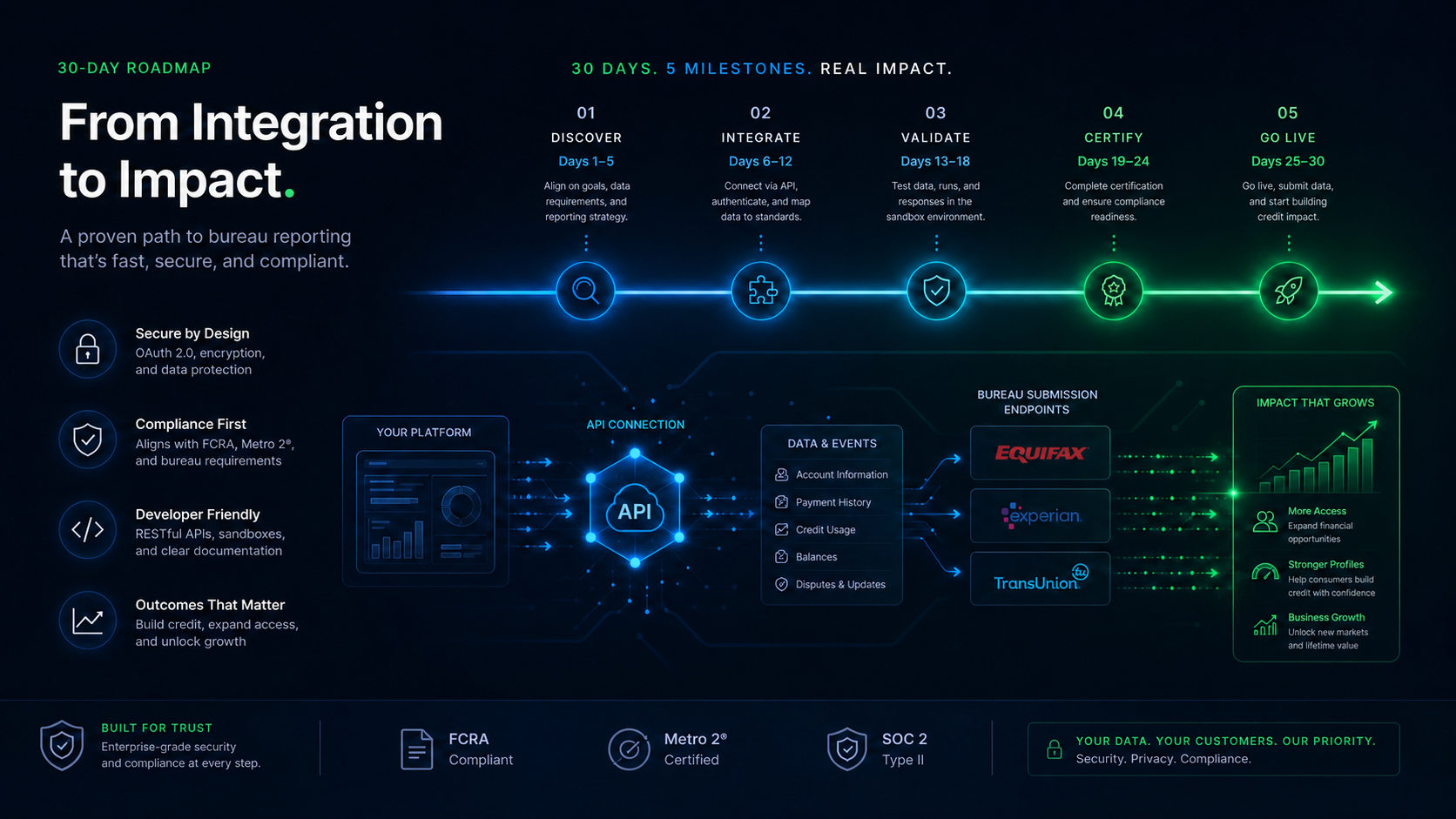
How Fintech Lenders Can Embed Credit Bureau Reporting in 30 Days
A proven 30-day roadmap for BNPL platforms, neobanks, and fintech lenders to embed fully compliant Metro 2® credit bureau reporting — without building a custom engine or risking FCRA liability.
In the rapidly evolving landscape of fintech lending, the ability to report consumer payment data to major credit bureaus is no longer just a compliance checkbox — it is a fundamental product feature and a competitive differentiator. Whether you are building a Buy Now, Pay Later (BNPL) platform, a neobank, a rent-reporting service, or a payroll-linked credit app, your customers expect their on-time payments to build their credit scores. And increasingly, regulators expect you to report that data accurately.
The problem is that integrating with Equifax, Experian, TransUnion, and Innovis is notoriously complex. The CDIA mandates that all data furnishers use the highly rigid Metro 2® Format — a fixed-width file specification containing over 400 distinct data fields, dozens of segment types, and thousands of validation rules that are updated annually. For engineering and compliance teams, building a Metro 2® engine from scratch can consume months of developer time and expose the company to significant FCRA liability if data mapping errors slip through.
With the right infrastructure partner, fintech lenders can embed fully compliant credit bureau reporting into their platforms in just 30 days.
The Hidden Complexity of Metro 2® Compliance
A Metro 2® file is a structured report composed of distinct segments: the Base Segment (the core 426-character record containing account status, balance, payment history, and consumer identification), J1/J2 Segments for associated consumers and co-borrowers, K Segments for specialized loan types, and a Header and Trailer Record. Every field has a fixed byte position, a defined length, and a specific set of valid values. A single misaligned character will cause the credit bureau to reject the entire file.
The Three Hurdles That Derail Fintech Integrations
The Data Mapping Minefield
Your internal database schema almost certainly does not match the Metro 2® specification. Translating your internal loan statuses into the precise two-digit Metro 2® Account Status Codes requires deep domain expertise. The same is true for Compliance Condition Codes, ECOA Codes for co-signers, and the 24-Month Payment History Profile, which must be maintained and updated every single reporting cycle.
The FCRA Liability Trap
Under the FCRA and Regulation V, data furnishers have a strict, ongoing legal obligation to report accurate and up-to-date information. If your homegrown software miscalculates the Date of First Delinquency (DOFD) — the critical date that starts the seven-year purge period for derogatory accounts — you are not just creating a bad customer experience. You are committing an FCRA violation, triggering costly consumer disputes, potential CFPB enforcement actions, and reputational damage that can be existential for an early-stage fintech.
The Bureau Onboarding Bottleneck
Each of the four major credit bureaus has its own onboarding process, testing environment, minimum account requirements, and vendor approval process. Equifax requires a minimum of 500 open-balance accounts for direct reporting (with exceptions for banks, credit unions, and BHPH dealers). TransUnion requires 100 accounts in the first month. Innovis requires 5,000 accounts for direct reporting. Navigating these hurdles without an experienced partner can stall a product launch for an entire quarter.
Real-World Example: The BNPL Data Mapping Disaster
Consider the case of a rapidly growing Buy Now, Pay Later startup. The company's engineering team spent two months building a custom Python script to export their PostgreSQL database into a Metro 2® file. They were smart engineers, but they were not Metro 2® experts. They misunderstood the CDIA guidelines regarding the Highest Credit / Original Loan Amount field versus the Credit Limit field for short-term installment loans. They also failed to correctly map the Date of First Delinquency for accounts that missed a payment but later caught up.
When they submitted their first file to TransUnion, it was flagged with a critical error rate. Worse, for the accounts that did process, thousands of consumers saw their credit scores drop — not rise — because the startup's software had incorrectly classified the accounts as "Revolving" rather than "Installment." This misclassification caused the credit bureaus to calculate a sky-high credit utilization ratio, penalizing the very consumers the platform had promised to help.
The startup spent the following three months manually responding to e-OSCAR disputes, fielding angry social media posts, and ultimately scrapping their internal code entirely. The total cost — in engineering hours, legal fees, dispute resolution labor, and customer churn — exceeded $200,000.
Had they integrated the Hutchins Systems Metro 2® REST API from day one, the validation engine would have flagged the portfolio type mismatch and the DOFD errors before the file ever reached the bureau. The entire disaster was preventable.
The 30-Day Roadmap to Embedded Credit Reporting
Since 1986, Hutchins Systems has guided thousands of lenders, fintech platforms, and software vendors through the Metro 2® compliance journey. Here is the exact 30-day blueprint your team can follow to go live.
Foundation — Data Mapping & Bureau Agreements
- Sign Data Furnisher Agreements with each credit bureau you intend to report to
- Build the Business Requirements Document (BRD) — map every internal data field to its Metro 2® equivalent
- Define how your system handles edge cases: charge-offs, bankruptcies, hardship deferrals, account transfers
- Receive API credentials and sandbox access — developers understand the API contract by Day 10
Build & Validate — Integration & Validation
- Connect the Metro 2® REST API — send JSON payloads with consumer account data
- Run the Hutchins Systems validation engine: 1,000,000+ checks per 1,000 accounts
- Review detailed API error responses specifying exact field, invalid value, and correct Metro 2® enumeration
- Iterate until test files achieve 100% compliance score — typically 5–7 days of active development
Launch — Bureau Submission & Go-Live
- Submit the first Metro 2® file to bureau acceptance testing environments
- Review tradeline data on sample consumer accounts to verify accuracy
- Go live — begin automated monthly reporting fulfilling your promise to users
- Hutchins Systems API handles all annual CDIA specification updates automatically
Choosing the Right Integration Path
While the REST API is the gold standard for digitally native fintechs, Hutchins Systems recognizes that the lending ecosystem is diverse. That is why we offer a complete suite of Metro 2® products designed to meet you exactly where you are.
| Product | Best For | Key Feature |
|---|---|---|
| Metro 2® REST API | SaaS & fintech platforms | Real-time, automated reporting via JSON/CSV/Excel |
| MORFi Cloud | Growing lenders, spreadsheet-driven ops | Upload Excel/CSV → instant compliant Metro 2® file |
| Credit Time 2000® | SMB lenders, BHPH dealers | Experian-approved preferred vendor since 1986 |
Critically, all Hutchins Systems products include free, unlimited phone and email support. While competitors frequently charge $80 or more per hour to help you decipher a bureau rejection code, our team of Metro 2® experts is available to ensure your reporting is flawless, month after month.
The Strategic Case for Flawless Credit Reporting
In 2026, the regulatory and competitive landscape is converging in a way that makes accurate credit bureau reporting more important than ever. The CFPB is actively scrutinizing data furnishers. New York has proposed comprehensive BNPL regulations that include specific data accuracy and dispute resolution requirements. The CDIA updates the Metro 2® specification annually. And consumers — empowered by apps that show them their credit scores in real time — will notice and complain loudly when a payment they made on time shows up incorrectly on their credit report.
For fintech lenders, embedding credit bureau reporting is not just about avoiding FCRA liability. It is about building a product that delivers on its promise, earns consumer trust, and differentiates your platform in an increasingly crowded market.
Ready to Embed Credit Bureau Reporting in 30 Days?
Schedule a free technical consultation with our Metro 2® API team. We'll walk you through the integration architecture, data mapping requirements, and bureau onboarding process for your specific platform.